Thursday, April 7, 2011
Wednesday, March 23, 2011
Bangladeshi Bird Bulbuls
Order: Passeriformes.
Family: Pycnonotidae
Bulbuls are medium-sized songbirds. Some are colourful with yellow, red or orange vents, cheeks, throat or supercilia, but most are drab, with uniform olive brown to black plumage. Some species have distinct crests.There are 130 species worldwide and 11 species which occur in Bangladesh.
PHOTO GALLERY
PHOTO GALLERY
![]() |
| Red-whiskered Bulbul |
BANGLADESHI SPARROW
Angladesh is full of natural gifts. The gifts are: flower, birds, forest, river, climate, fruit, jute, tea, fertile clay etc. All of them, bird is my topic. I am writing about a little bird and its description. Its name is Sparrow. It is a common bird. Every body has enough idea about it and it is a known bird to all. It is brown and white in color but its head and eye side are black. It is not a forest bird.
Sparrows make its nest at the corner on the ceiling by straw, rope, dry branch etc. It likes to live with people. Its food item is normal. Anybody cannot catch for cage it. The male Sparrow is more beautiful then the female Sparrow. When they want to fall in love or choose another Sparrow then the female Sparrow try to show extra and special attraction for the male Sparrow. They are cunning bird. If they could sing that will be more beautiful side. Some naughty boys catch it and fry it to eat. At night the bad boys catch it. We should protect them from bad persons.
![]() |
| House Sparrow |
Thursday, February 24, 2011
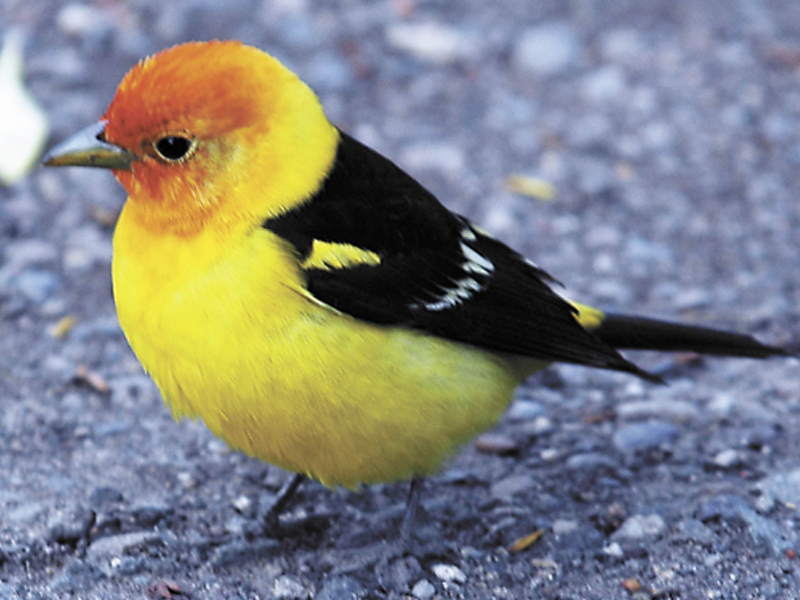
WESTERN TANAGER
Piranga ludoviciana
Bird Spotting: The male western tangier has a red head with bright yellow wing shoulders and belly. Wings are black with white and yellow wing bar markings. The female bird is a yellowish green on top with gray wings. The rump is yellowish.
Habitat: The western tangier makes its home in open coniferous and mixed forests.
Nesting: Three to five speckled bluish-green eggs are laid in a frail, shallow saucer nest constructed of small roots, weeds and bark. Nests can be found lashed to a branch of a tree, usually at a low elevation.
Bird Bite: The bright red pigment called rhodoxanthin is rare in birds and does not come naturally to the western tangier. Eating insects that have ingested plants with this pigment gives the western tangier its distinctive red face.
There were traditionally about 240 species of tanagers, but the taxonomic treatment of this family's members is currently in a state of flux. As more of these birds are studied using modern molecular techniques it is expected that some genera may be relocated elsewhere. Already species in the genera Euphonia and Chlorophonia, which were once considered part of the tanager family, are now treated as members of Fringillidae, in their own subfamily (Euphoniinae). Likewise the genera Piranga (which includes the Scarlet Tanager, Summer Tanager, and Western Tanager), Chlorothraupis, and Habia appear to be members of the Cardinal family, and have been reassigned to that family by the AOU.
Wednesday, February 2, 2011
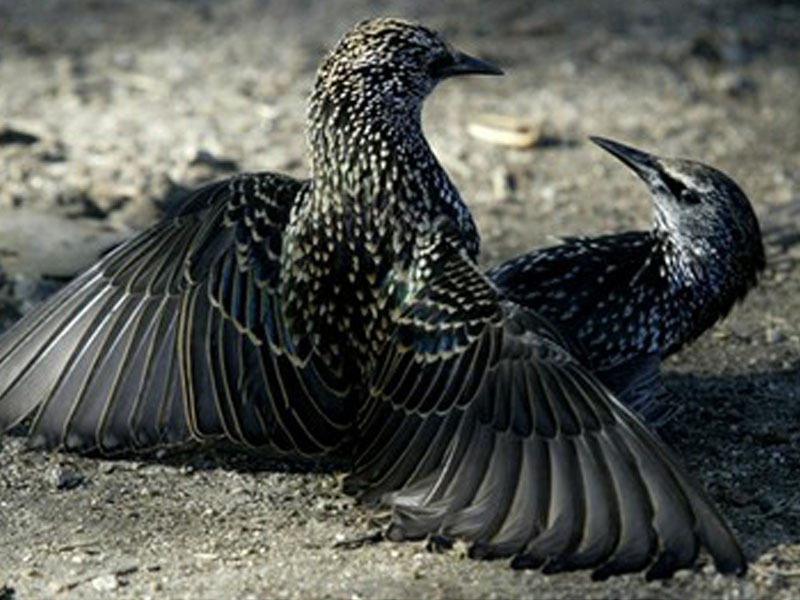
STARLINGS OF EUROPE ASIA AND AFRICA
Starlings are small to medium-sized passerine birds in the family Sturnidae. The name "Sturnidae" comes from the Latin word for starling, sturnus. Starlings occur naturally in the Old World, from Europe, Asia and Africa, to northern Australia and the islands of the tropical Pacific. Several European and Asian species have been introduced to these areas as well as North America, Hawaii and New Zealand, where they generally compete for habitat with native birds and are considered to be invasive species. The starling species familiar to most people in Europe and North America is the European Starling, and throughout much of Asia and the Pacific the Common Myna is indeed common.
Starlings have diverse and complex vocalizations, and have been known to embed sounds from their surroundings into their own calls, including car alarms, and human speech patterns. The birds can recognize particular individuals by their calls, and are currently the subject of research into the evolution of human language.
Description
The starlings are medium sized passerines. The shortest-bodied species is Kenrick's Starling (Poeoptera kenricki), at 15 centimetres (6 in), but the lightest-weight species is Abbott's Starling (Poeoptera femoralis), at 34 grams (1.2 oz). The largest starlings are the mynas of the genus Mino, especially the Yellow-faced(Mino dumontii) and Long-tailed Mynas (Mino kreffti). These mynas can exceed 30 centimetres (1 ft) and weigh over 225 grams (8 oz). Several species of starling exhibit sexual dimorphism in size, with the males being larger than the females.There is less sexual dimorphism in plumage however, with only 25 species showing such differences between the sexes. The plumage of the starlings is often brightly coloured due to iridescence; this colour is derived from the structure of the feathers, not from any pigment. Some species of Asian starling have crests or erectile feathers on the crest. Other ornamentation includes elongated tail feathers and brightly coloured bare areas on the face. These colours can be derived from pigments, or, as in the Bali Starling, structural colour, caused by light scattering off parallel collagen fibres. The irises of many species are red and yellow, although those of younger birds are much darker.
Distribution Habitat and Movements
The starlings inhabit a wide range of habitats from the Arctic Circle to the Equator, in fact the only habitat they do not typically occupy is the driest sandy deserts. The family is naturally absent from the Americas and from large parts of Australia, but is present over the majority of Europe, Africa and Asia. The genus Aplonishas also spread widely across the islands of the Pacific reaching Polynesia, Melanesia and Micronesia (in addition one species in the genus Mino has reached the Solomon Islands, it is also a species of this genus that is the only starling found in northern Australia.Asian species are most common in evergreen forests; 39 species found in Asia are predominately forest birds as opposed to 24 found in more open or human modified environments. In contrast to this African species are more likely to be found in open woodlands and savannah; 32 species are open area specialists compared to 13 true forest species. The high diversity of species found in Asia and Africa is not matched by Europe, which has one widespread (and very common) species and two more restricted species. The European Starling is both highly widespread and extre mely catholic in its habitat, occupying most types of open habitat. Like many other starling species it has also adapted readily to human-modified habitat, including farmland, orchards, plantations and urban areas.Some species of starling are migratory, either entirely, like the Shelley's Starling, which breeds in Ethiopia and northern Somalia and migrates to Kenya and southern Somalia, or the White-shouldered Starling, which is migratory in part of its range but is resident in others.
Behaviour
The starlings are generally a highly social family. Most species associate in flocks of varying sizes throughoutthe year, these flocks may include other species of starlings and sometimes species from other families. This sociality is particularly evident in the their roosting behaviour; in the non-breeding season some roosts can number in the thousands of birds.
Diet and feeding
The diets of the starlings are usually dominated by fruits and insects. Many species are important dispersers of seeds in Asia and Africa, for example white sandlewood, Indian Banyan. In addition to trees they are also important dispersers of parasitic mistletoes. In South Africa the Red-winged Starling is an important disperser of the introduced Acacia cyclops. Starlings have been observed feeding on fermenting over-ripe fruit, which led to the speculation that they might become intoxicated by the alcohol. Laboratory experiments on European Starlings have found that they have disposal enzymes that allow them to break down alcohol very quickly. In addition to consuming fruits, many starlings will also consume nectar. The extent to which starlings are important pollinators is unknown, but at least some are, such as the Slender-billed Starling of alpine East Africa, which pollinates giant lobelias.
PHOTO GALLERY
The diets of the starlings are usually dominated by fruits and insects. Many species are important dispersers of seeds in Asia and Africa, for example white sandlewood, Indian Banyan. In addition to trees they are also important dispersers of parasitic mistletoes. In South Africa the Red-winged Starling is an important disperser of the introduced Acacia cyclops. Starlings have been observed feeding on fermenting over-ripe fruit, which led to the speculation that they might become intoxicated by the alcohol. Laboratory experiments on European Starlings have found that they have disposal enzymes that allow them to break down alcohol very quickly. In addition to consuming fruits, many starlings will also consume nectar. The extent to which starlings are important pollinators is unknown, but at least some are, such as the Slender-billed Starling of alpine East Africa, which pollinates giant lobelias.
PHOTO GALLERY
Sunday, January 30, 2011
WARBLER BIRD
There are a number of Passeriformes (perching birds) called "warblers". They are not particularly closely related, but share some characteristics, such as being fairly small, vocal and insectivorous. They are mostly brownish or dull greenish in color. They tend to be more easily heard than seen. Identification can be difficult and may be made on the basis of song alone. To English-speaking Europeans
The grass-warblers are small passerine birds belonging to the genus Locustella. Formerly placed in the paraphyletic "Old World warbler" assemblage, they are now considered the northernmost representatives of a largely Gondwanan family, the Megaluridae. These are rather drab brownish "warblers" usually associated with fairly open grassland, shrubs or marshes. Some are streaked, others plain, all are difficult to view. They are insectivorous. The most characteristic feature of this group is that the song of several species is a mechanical insect-like reeling which gives rise to the group's scientific name. Species breeding in temperate regions are strongly migratory.
Subscribe to:
Posts (Atom)