
The Life of Sweet Birds
Thursday, February 24, 2011


Wednesday, February 2, 2011
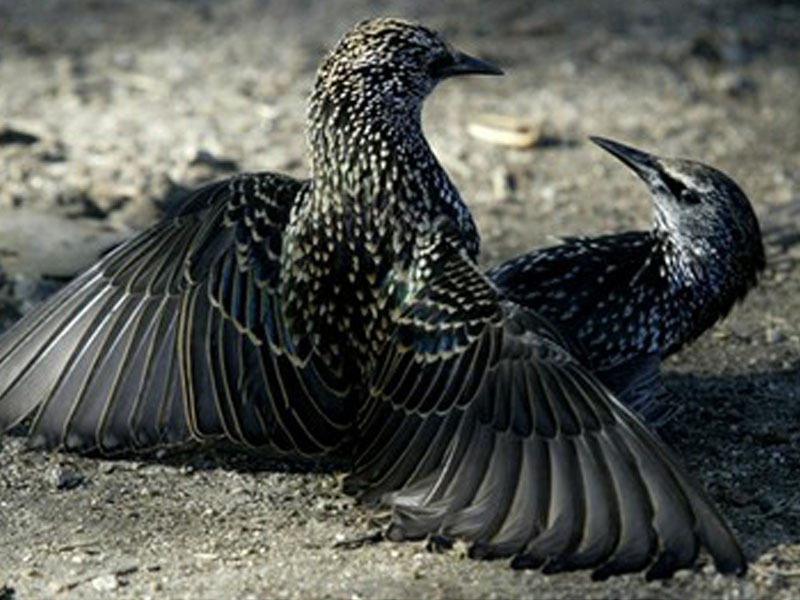
STARLINGS OF EUROPE ASIA AND AFRICA

Starlings are small to medium-sized passerine birds in the family Sturnidae. The name "Sturnidae" comes from the Latin word for starling, sturnus. Starlings occur naturally in the Old World, from Europe, Asia and Africa, to northern Australia and the islands of the tropical Pacific. Several European and Asian species have been introduced to these areas as well as North America, Hawaii and New Zealand, where they generally compete for habitat with native birds and are considered to be invasive species. The starling species familiar to most people in Europe and North America is the European Starling, and throughout much of Asia and the Pacific the Common Myna is indeed common.
Starlings have diverse and complex vocalizations, and have been known to embed sounds from their surroundings into their own calls, including car alarms, and human speech patterns. The birds can recognize particular individuals by their calls, and are currently the subject of research into the evolution of human language.
Description
The starlings are medium sized passerines. The shortest-bodied species is Kenrick's Starling (Poeoptera kenricki), at 15 centimetres (6 in), but the lightest-weight species is Abbott's Starling (Poeoptera femoralis), at 34 grams (1.2 oz). The largest starlings are the mynas of the genus Mino, especially the Yellow-faced(Mino dumontii) and Long-tailed Mynas (Mino kreffti). These mynas can exceed 30 centimetres (1 ft) and weigh over 225 grams (8 oz). Several species of starling exhibit sexual dimorphism in size, with the males being larger than the females.There is less sexual dimorphism in plumage however, with only 25 species showing such differences between the sexes. The plumage of the starlings is often brightly coloured due to iridescence; this colour is derived from the structure of the feathers, not from any pigment. Some species of Asian starling have crests or erectile feathers on the crest. Other ornamentation includes elongated tail feathers and brightly coloured bare areas on the face. These colours can be derived from pigments, or, as in the Bali Starling, structural colour, caused by light scattering off parallel collagen fibres. The irises of many species are red and yellow, although those of younger birds are much darker.
The starlings are medium sized passerines. The shortest-bodied species is Kenrick's Starling (Poeoptera kenricki), at 15 centimetres (6 in), but the lightest-weight species is Abbott's Starling (Poeoptera femoralis), at 34 grams (1.2 oz). The largest starlings are the mynas of the genus Mino, especially the Yellow-faced(Mino dumontii) and Long-tailed Mynas (Mino kreffti). These mynas can exceed 30 centimetres (1 ft) and weigh over 225 grams (8 oz). Several species of starling exhibit sexual dimorphism in size, with the males being larger than the females.There is less sexual dimorphism in plumage however, with only 25 species showing such differences between the sexes. The plumage of the starlings is often brightly coloured due to iridescence; this colour is derived from the structure of the feathers, not from any pigment. Some species of Asian starling have crests or erectile feathers on the crest. Other ornamentation includes elongated tail feathers and brightly coloured bare areas on the face. These colours can be derived from pigments, or, as in the Bali Starling, structural colour, caused by light scattering off parallel collagen fibres. The irises of many species are red and yellow, although those of younger birds are much darker.
Distribution Habitat and Movements

Behaviour
The starlings are generally a highly social family. Most species associate in flocks of varying sizes throughoutthe year, these flocks may include other species of starlings and sometimes species from other families. This sociality is particularly evident in the their roosting behaviour; in the non-breeding season some roosts can number in the thousands of birds.
The starlings are generally a highly social family. Most species associate in flocks of varying sizes throughoutthe year, these flocks may include other species of starlings and sometimes species from other families. This sociality is particularly evident in the their roosting behaviour; in the non-breeding season some roosts can number in the thousands of birds.
Diet and feeding
The diets of the starlings are usually dominated by fruits and insects. Many species are important dispersers of seeds in Asia and Africa, for example white sandlewood, Indian Banyan. In addition to trees they are also important dispersers of parasitic mistletoes. In South Africa the Red-winged Starling is an important disperser of the introduced Acacia cyclops. Starlings have been observed feeding on fermenting over-ripe fruit, which led to the speculation that they might become intoxicated by the alcohol. Laboratory experiments on European Starlings have found that they have disposal enzymes that allow them to break down alcohol very quickly. In addition to consuming fruits, many starlings will also consume nectar. The extent to which starlings are important pollinators is unknown, but at least some are, such as the Slender-billed Starling of alpine East Africa, which pollinates giant lobelias.
PHOTO GALLERY


The diets of the starlings are usually dominated by fruits and insects. Many species are important dispersers of seeds in Asia and Africa, for example white sandlewood, Indian Banyan. In addition to trees they are also important dispersers of parasitic mistletoes. In South Africa the Red-winged Starling is an important disperser of the introduced Acacia cyclops. Starlings have been observed feeding on fermenting over-ripe fruit, which led to the speculation that they might become intoxicated by the alcohol. Laboratory experiments on European Starlings have found that they have disposal enzymes that allow them to break down alcohol very quickly. In addition to consuming fruits, many starlings will also consume nectar. The extent to which starlings are important pollinators is unknown, but at least some are, such as the Slender-billed Starling of alpine East Africa, which pollinates giant lobelias.
PHOTO GALLERY



Sunday, January 30, 2011
WARBLER BIRD

There are a number of Passeriformes (perching birds) called "warblers". They are not particularly closely related, but share some characteristics, such as being fairly small, vocal and insectivorous. They are mostly brownish or dull greenish in color. They tend to be more easily heard than seen. Identification can be difficult and may be made on the basis of song alone. To English-speaking Europeans

The grass-warblers are small passerine birds belonging to the genus Locustella. Formerly placed in the paraphyletic "Old World warbler" assemblage, they are now considered the northernmost representatives of a largely Gondwanan family, the Megaluridae. These are rather drab brownish "warblers" usually associated with fairly open grassland, shrubs or marshes. Some are streaked, others plain, all are difficult to view. They are insectivorous. The most characteristic feature of this group is that the song of several species is a mechanical insect-like reeling which gives rise to the group's scientific name. Species breeding in temperate regions are strongly migratory.
MOCKING BIRD

Shot this birds on a nearly hours of a winter day. This bird is very approachable and friendly, in this instance it allowed me to go as close as 5 and click these pics.
Mockingbirds are a group of New World passerine birds from the Mimidae family. They are best known for the habit of some species mimicking the songs of other birds and the sounds of insects and amphibians, often loudly and in rapid succession. There are about 17 species in three genera. These do not appear to form a monophyletic lineage: Mimus and Nesomimus are quite closely related; their closest living relatives appear to be some thrashers, such as the Sage Thrasher. Melanotis is more distinct; it seems to represent a very ancient basal lineage of Mimidae.
PHOTO GALLERY


Wednesday, January 26, 2011
HUMMINGBIRDS

Hummingbirds are birds that comprise the family Trochilidae. They are among the smallest of birds, and include the smallest extant bird species, the Bee Hummingbirds. They can hover in mid-air by rapidly flapping their wings 12–90 times per second (depending on the species). They can also fly backwards, and are the only group of birds able to do so. Their English name derives from the characteristic hum made by their rapid wing beats. They can fly at speeds exceeding 15 m/s (54 km/h, 34 mi/h).
Most hummingbirds have bills that are long and straight or nearly so, but in some species the bill shape is adapted for specialized feeding. Thornbills have short, sharp bills adapted for feeding from flowers with short corollas and piercing the bases of longer ones. The Sicklebills' extremely decurved bills are adapted to extracting nectar from the curved corollas of flowers in the family Gesneriaceae. The bill of the Fiery-tailed Awlbill has an upturned tip, as in the Avocets. The male Tooth-billed Hummingbird has barracuda-like spikes at the tip of its long, straight bill.

Hummingbirds are specialized nectarivores and are tied to the ornithophilous flowers they feed upon. Some species, especially those with unusual bill shapes such as the Sword-billed Hummingbird and the sicklebills, are co-evolved with a small number of flower species.
Many plants pollinated by hummingbirds produce flowers in shades of red, orange, and bright pink, though the birds will take nectar from flowers of many colors. Hummingbirds can see wavelengths into the near-ultraviolet, but their flowers do not reflect these wavelengths as many insect-pollinated flowers do. This narrow color spectrum may render hummingbird-pollinated flowers relatively inconspicuous to most insects, thereby reducing nectar robbing. Hummingbird-pollinated flowers also produce relatively weak nectar (averaging 25% sugars w/w) containing high concentrations of sucrose, whereas insect-pollinated flowers typically produce more concentrated nectars dominated by fructose and glucose.

Hummingbird flight has been studied intensively from an aerodynamic perspective using wind tunnels and high-speed video cameras.Writing in Nature, the biomechanist Douglas Warrick and coworkers studied the Rufous Hummingbird, Selasphorus rufus, in a wind tunnel using particle image velocimetry techniques and investigated the lift generated on the bird's upstroke and downstroke. They concluded that their subjects produced 75% of their weight support during the downstroke and 25% during the upstroke. Many earlier studies had assumed (implicitly or explicitly) that lift was generated equally during the two phases of the wingbeat cycle, as is the case of insects of a similar size. This finding shows that hummingbirds' hovering is similar to, but distinct from, that of hovering insects such as the hawk moths.
The Giant Hummingbird's wings beat at 8–10 beats per second, the wings of medium-sized hummingbirds beat about 20–25 beats per second and the smallest can reach 100 beats per second during courtship displays.

Reproduction
As far as is known, male hummingbirds do not take part in nesting. Most species build a cup-shaped nest on the branch of a tree or shrub, though a few tropical species normally attach their nests to leaves. The nest varies in size relative to species, from smaller than half of a walnut shell to several centimeters in diameter. In many hummingbird species, spider silk is used to bind the nest material together and secure the structure to its support. The unique properties of silk allow the nest to expand with the growing young. Two white eggs are laid, which, despite being the smallest of all bird eggs, are in fact large relative to the hummingbird's adult size. Incubation lasts 14 to 23 days, depending on species, ambient temperature, and female attentiveness to the nest. Their mother feeds the nestlings on small arthropods and nectar by inserting her bill into the open mouth of a nestling and regurgitating the food into its crop.
PHOTO GALLERY


 |
| Hummingbird among and Crocosmia |
 |
| Hummingbird is attacking a much bigger bird. |
Tuesday, January 25, 2011
RED-BELLIED WOODPECKER

The Red-bellied Woodpecker, Melanerpes carolinus, is a medium-sized woodpecker of the Picidae family. It breeds in southern Canada and the northeastern United States, ranging as far south as Florida and as far west as Texas. Its common name is somewhat misleading, as the most prominent red part of its plumage is on the head; the Red-headed Woodpecker however is another species that is a rather close relative but looks entirely different.
Description
Adults are mainly light gray on the face and underparts; they have black and white barred patterns on their back, wings and tail. Adult males have a red headside going from the bill to the nape; females have a red patch on the nape and another above the bill. The reddish tinge on the belly that gives the bird its name is difficult to see in field identification. They are 9 to 10.5 inches long, and have a wingspan of 15 to 18 inches.
Vocalizations
Red-bellied woodpeckers are noisy birds, and have many varied calls. Calls have been described as sounding like churr-churr-churr or chuf-chuf-chuf with an alternating br-r-r-r-t sound. Males tend to call and drum more frequently than females, but both sexes call. Often, these woodpeckers "drum" to attract mates. They tap on aluminum roofs, metal guttering, hollow trees and even transformer boxes, in urban environments, to communicate with potential partners.
It was first described in Linnaeus' Systema Naturae, as Picus carolinus.. The type locality is given simply as "America septentrionalis" (North America).
CARDINAL RED BIRDS

A cardinal is a type of bird that is found in North and South America. There are lots of types of cardinals. The type of cardinal that most people think of when they think of the bird cardinal is the Northern Cardinal. The male Northern Cardinal has bright red feathers. The cardinal got its name from these bright red feathers as it is named after the Cardinal that is the Catholic leader. The Catholic cardinal wears bright red clothing.
The Northern Cardinal is found in North America. The males have bright red feathers, a black face, and coral or red beaks. The females are tan and may have slightly red wings or tail feathers. They both have strong beaks, long tails, and raised crests. They grow to 7 to 9 inches tall.
A pair of Northern Cardinals will nest together. They will both feed the baby cardinals. The male is territorial and will sing a loud song that is meant to worn other male cardinals to stay away. The female cardinal will build the nest typically in a low tree branch or a bush.
The male cardinal is very defensive of its territory and will fight off other males. It is even known to start a fight with its own reflection!
It is thought that the cardinal uses songs to communicate. The female and male will sing back and forth to each other. The typical song of the Northern Cardinal starts with a series of loud, clear whistles. Cardinals will sing sharp "chips" as an alarm song as well.
Baby Northern Cardinals will all be tan like their mom. The males will get their red feathers as they grow into adults. The babies are born from white eggs with brown spots. The female will lay between one and five eggs with a typical clutch having three eggs. The babies are helpless when born and the mom and dad birds both collect food to feed them.
Cardinals like to forage for food at dawn and dusk. They eat insects, fruit, and seeds.
The Northern Cardinal is a popular bird in the United States. It is the most popular state bird as it is the official state bird of seven of the US states including North Carolina, West Virginia, Ohio, Illinois, Indiana, Kentucky, and Virginia. The cardinal is also the team mascot for some universities (Louisville) and professional sports teams.
PHOTO GALLERY


 |
| Cardinal Eggs in nest |
Subscribe to:
Posts (Atom)